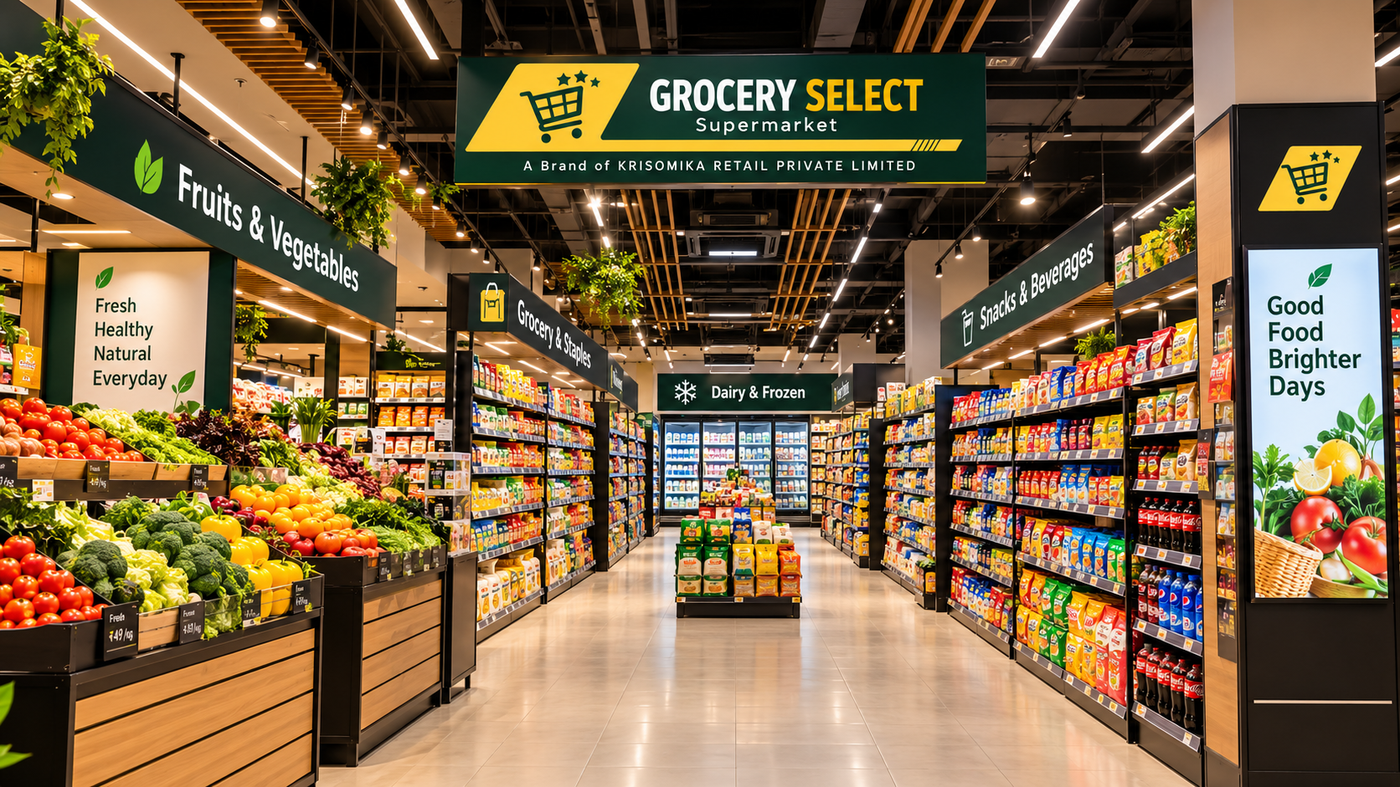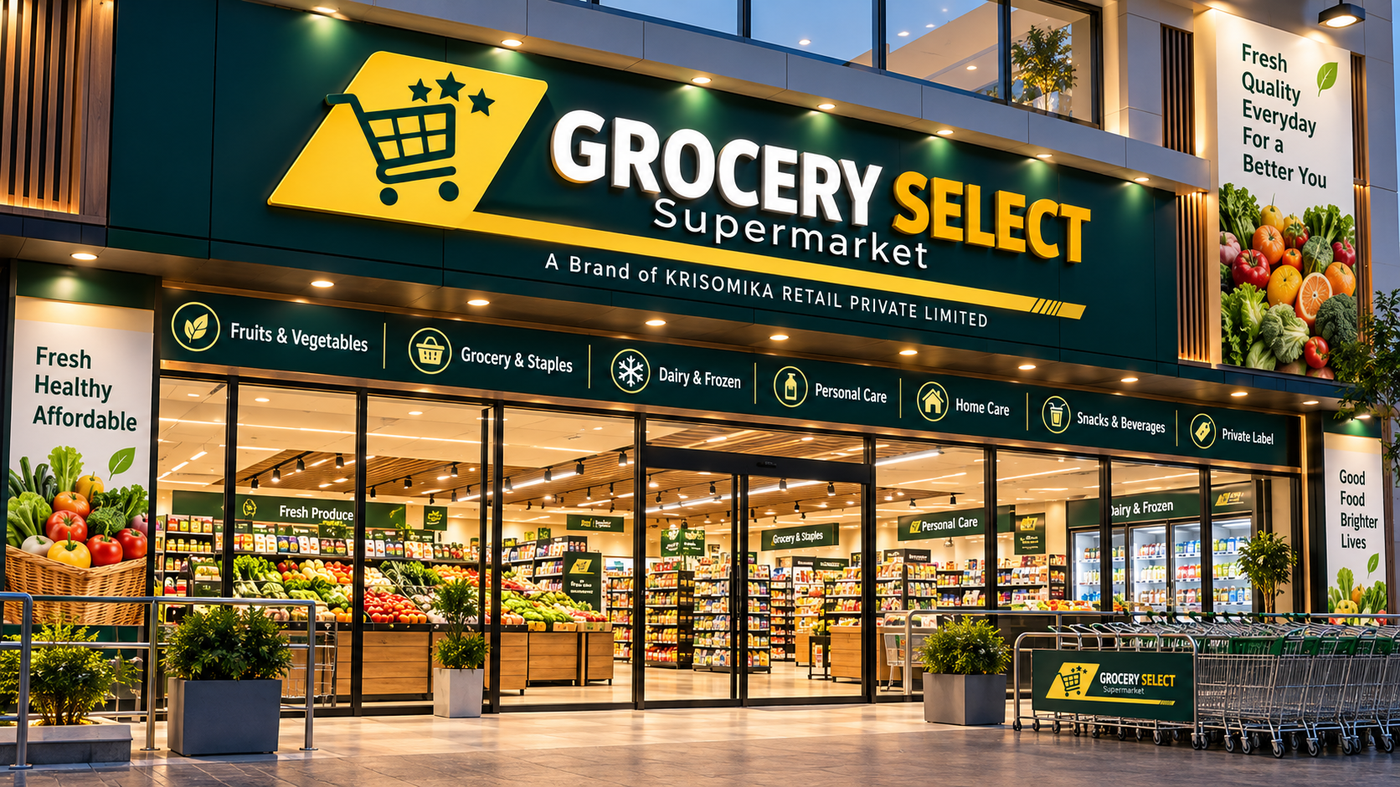
India's grocery and everyday-needs retail market is evolving fast. Shoppers now expect organized stores, reliable product availability, transparent pricing, digital payments, and a dependable retail experience. For entrepreneurs, this shift creates a real opening: entering organized retail through a grocery store franchise rather than building an independent brand from the ground up.
Grocery Select, a supermarket franchise brand operated by Krisomika Retail Private Limited, is built around a FOFO — Franchise Owned, Franchise Operated model. If you're evaluating a supermarket franchise in India, this guide walks through what it actually takes to start one: store formats, investment, operations, technology, and the questions you should ask before signing anything.
What Is a Grocery Franchise?
Rather than independently building a brand identity, store concept, product assortment, operating procedures, technology stack, and marketing assets from scratch, a franchisee steps into a structured business framework already built by the franchisor. The franchisee typically invests in the store, inventory, local operations, staffing, and working capital — while the franchisor provides the brand, systems, guidelines, and technology under the franchise agreement.
Why a Mart Franchise Makes Sense
Grocery is essential, recurring consumption — staples, packaged foods, personal care, home care, and daily-use household products don't wait for a special occasion. That said, demand alone doesn't guarantee profitability. Success comes down to location, assortment, pricing, inventory discipline, service, and marketing working together — which is exactly where a structured mart franchise model earns its keep.
The FOFO Model at Grocery Select
Under FOFO, the franchisee owns and runs the outlet using the Grocery Select brand and systems.
Franchisee typically handles: store investment, interiors, inventory, hiring, day-to-day operations, local expenses, customer service, local marketing, and compliance with brand standards.
Grocery Select typically supports: brand usage, store concept and design guidelines, technology (POS/ERP/inventory), marketing support, launch assistance, and ongoing operational guidance.
Exact rights, fees, territory, and commercial terms are always confirmed in the executed franchise agreement.
Store Formats
A grocery store franchise with Grocery Select scales across formats depending on the market:
| Format | Approximate Area |
|---|---|
| Compact Grocery Store | 300+ sq. ft. |
| Neighborhood Supermarket | 600–1,000 sq. ft. |
| Large Supermarket | 1,000–3,000 sq. ft. |
| Large Format Store | 3,000–5,000 sq. ft. |
Bigger isn't automatically better — the right size matches the local catchment, competition, and investment capacity.
Investment Breakdown
The total investment goes beyond a single fee line item. Here's what typically makes up a Grocery Select super market franchise:
- Franchise Fee: ₹2,25,000 + 18% GST (₹2,65,500 total)
- Software Fee: ₹75,000 + 18% GST (₹88,500 total)
- Security Deposit: ₹2,00,000 (refundable)
- Interior & Product Investment: tiered by store size — ₹1,200/sq. ft. for 300–600 sq. ft., ₹1,100/sq. ft. for 600–1,000 sq. ft., ₹1,000/sq. ft. above 1,000 sq. ft. (applies to both interior fit-out and initial product purchasing)
- Royalty: nil for the first 6 months, then 3% of gross monthly sales from month 7 onward — applied to full gross sales, with no cap
Illustrative example (1,000 sq. ft. store, ₹1,100/sq. ft. tier):
- Interior: 1,000 × ₹1,100 = ₹11,00,000
- Initial inventory: 1,000 × ₹1,100 = ₹11,00,000
- Franchise Fee (incl. GST): ₹2,65,500
- Software Fee (incl. GST): ₹88,500
- Security Deposit: ₹2,00,000
- Subtotal: ≈ ₹27,54,000
Beyond this subtotal, factor in rent advances, licenses, equipment, staff salaries, launch marketing, and working capital before finalizing your budget. Store operating expenses — salaries, electricity, restocking, and other running costs — are borne by the franchisee.
What Grocery Select supports beyond the fee includes store location selection, software & IT support, GRN processing, marketing (online & offline), hiring & training, purchase support, store layout & signage, staff uniforms, license support, membership cards, 3 months of accounting support, and social media advertising across Instagram, Facebook, YouTube, and LinkedIn.
Franchise terms include 2 km territorial exclusivity, a 5-year term (renewable for another 5), and a 1-year lock-in.
Location Is Everything
A supermarket with a great product mix can still underperform in the wrong spot. Evaluate:
- Population density and residential concentration within your catchment
- Visibility and accessibility from the road
- Parking availability
- Existing competition — kiranas, other supermarkets, discount stores, and quick-commerce platforms
- Rental economics relative to expected sales, not just footfall
A basic catchment study — roughly 1 km as your primary zone, 2–3 km secondary — covering households, offices, schools, and existing competitors goes a long way toward avoiding an expensive mistake.
What Goes on the Shelves
A modern Grocery Select store typically carries:
- Grocery & staples — rice, flour, pulses, oils, grains
- Packaged foods — snacks, biscuits, ready-to-eat, breakfast items
- Beverages — juices, soft drinks, tea, coffee
- Personal care & home care
- Fresh, dairy, and frozen (format and license dependent)
- Private-label products
Private Label: The Bigger Opportunity
Selling under your own brand identity — rather than relying entirely on third-party brands — can improve differentiation, category control, and margins. It does, however, demand real attention to product quality, packaging, compliance, and supply-chain reliability. Private label works best as a deliberate business function, not a shortcut.
Technology That Runs the Store
Grocery Select's technology roadmap centers on an AI-enabled, cloud-based retail platform combining POS, ERP, inventory, and centralized reporting — giving both individual franchisees and the broader network visibility into daily sales, SKU movement, and reorder needs. On the customer side, the roadmap extends to digital payments, WhatsApp-based ordering, loyalty programs, and potential ONDC integration.
Marketing: Local and Digital
Store-level marketing typically blends:
- Offline: signage, flyers, society campaigns, launch events
- Digital: Google Business Profile, Instagram, Facebook, WhatsApp, local SEO
- Community: partnerships with residential societies, schools, and local businesses
Compliance Checklist
Depending on location and store activity, expect to navigate company/GST registration, Shop & Establishment requirements, FSSAI (where applicable), fire and safety clearances, labour compliance, weights and measures rules, and signage permissions. Requirements vary by state and city — verify with qualified professionals before opening.
Common Mistakes to Avoid
- Choosing a location for low rent alone — commercial viability matters more
- Overstocking, which locks up working capital
- Skipping competitor analysis before signing the lease
- Weak product assortment that drives customers elsewhere
- Underestimating working capital beyond the initial store investment
The Franchise Journey, Step by Step
Enquiry → Initial Discussion → Qualification → Location Discussion → Commercial Proposal → Due Diligence → Agreement → Store Planning → Procurement & Setup → Staff Training → Launch → Ongoing Operations.
Is a Grocery Franchise Right for You?
It's worth considering whether you're a first-time entrepreneur, an existing retailer, an investor looking for an operating business, or someone expanding into organized retail — provided your financial capacity, location, and operational commitment line up.
No franchise model should be sold as a guaranteed-profit opportunity — actual results depend on location, execution, and market conditions. Review the full commercial proposal and franchise agreement, and complete your own financial and legal due diligence before committing.
Interested in a grocery store franchise or supermarket franchise opportunity? Submit your enquiry and tell us about your location and business plans — our franchise team will get in touch.
Grocery Select — Modern Retail. Smarter Operations. Stronger Communities.
Operated by Krisomika Retail Private Limited.