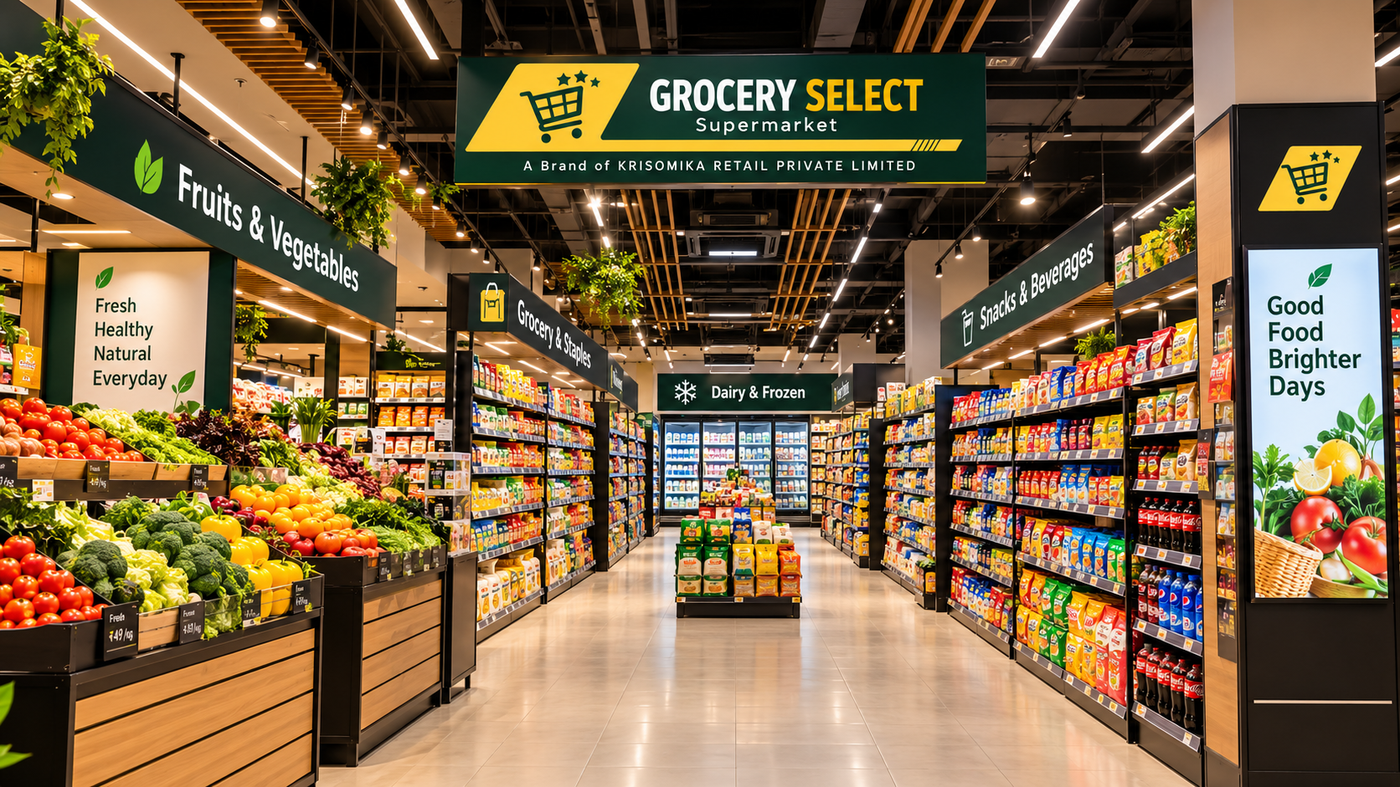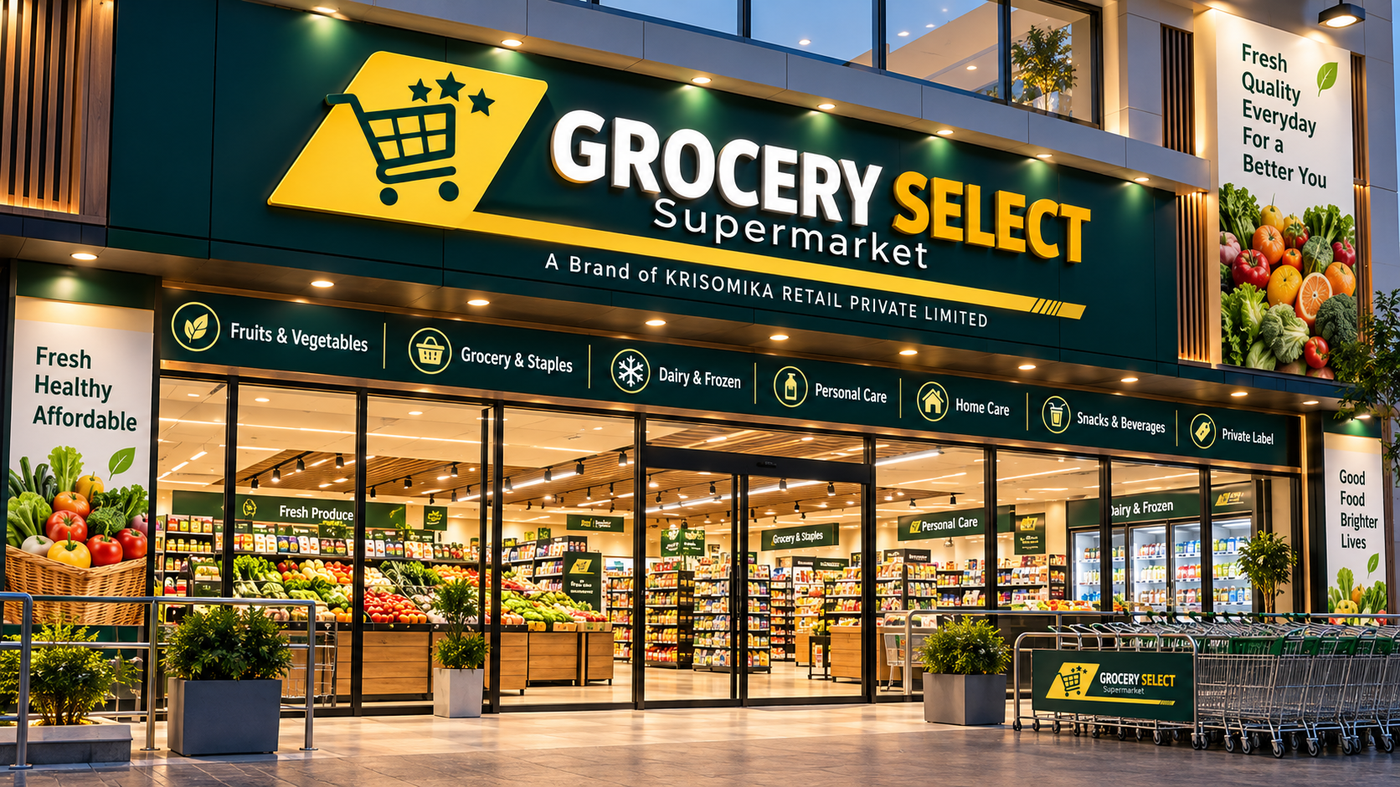
How to Start a Grocery Supermarket Franchise in India: Complete Guide to Investment, Setup, Operations & Growth India’s grocery and everyday-needs retail market continues to evolve rapidly. Consumers increasingly look for convenient shopping, organized stores, better product availability, transparent pricing, digital payment options, and a reliable retail experience. For entrepreneurs, this creates an opportunity to enter organized grocery retail through a grocery supermarket franchise rather than building an independent retail brand from scratch. A franchise model can provide access to an established brand identity, operating systems, technology, product categories, store planning, marketing support, and a structured business process. Grocery Select, a supermarket retail brand operated by Krisomika Retail Private Limited, is designed around a FOFO — Franchise Owned, Franchise Operated business model. This guide explains the major aspects of starting a grocery supermarket franchise in India, including store size, investment components, infrastructure, technology, inventory, operations, marketing, and important considerations before signing a franchise agreement. 1. What Is a Grocery Supermarket Franchise? A grocery supermarket franchise allows an entrepreneur to operate a retail store under an established supermarket brand. Instead of independently developing: Brand identity Store concept Product assortment Operating procedures Technology systems Marketing assets Customer acquisition processes Retail workflows the franchisee receives a structured business framework from the franchisor. The franchisee generally invests in the store, infrastructure, inventory, local operations, employees, and working capital, while the franchisor provides the brand framework, systems, guidelines, technology, and business support according to the franchise agreement. 2. Why Consider a Grocery Franchise Business? Grocery is an essential-consumption category. Unlike businesses dependent entirely on occasional purchases, grocery retail serves recurring household requirements such as: Staples Rice and flour Pulses Cooking oils Spices Beverages Snacks Personal care products Home-care products Packaged foods Daily-use household products This recurring demand is one reason entrepreneurs consider grocery retail as a long-term business category. However, demand alone does not guarantee profitability. A successful supermarket requires disciplined: Location + assortment + pricing + inventory management + customer service + marketing + operational control. That is where a structured franchise model can become useful. 3. Understanding the FOFO Franchise Model Grocery Select follows a FOFO — Franchise Owned, Franchise Operated approach. Under this structure, the franchisee owns and operates the outlet while using the Grocery Select brand and operating framework, subject to the terms of the franchise agreement. Franchisee responsibilities may include: Store investment Interior development Inventory investment Employee hiring Daily store operations Local expenses Customer service Local marketing Store maintenance Compliance with operating standards Brand/franchisor support may include: Brand usage Store concept and guidelines Business systems Technology platform POS/ERP integration Inventory-management systems Marketing support Store-launch support Operational guidance Product and category guidance The exact rights, responsibilities, fees, territories, procurement arrangements, support obligations, and commercial terms should always be confirmed in the executed franchise agreement. 4. Grocery Select Franchise Store Formats One of the advantages of grocery retail is that the store can be designed according to the available market and location. Grocery Select can be positioned across different retail formats, from compact neighborhood stores to larger supermarket and hypermarket-style outlets. Typical store-size planning Store Format Approximate Area Compact Grocery Store 300+ sq. ft. Neighborhood Supermarket 600–1,200 sq. ft. Large Supermarket 1,200–3,000 sq. ft. Large Format Store 3,000–5,000 sq. ft. The appropriate format depends on: Location Catchment population Competition Parking Footfall Rental economics Customer profile Product assortment Investment capacity A larger store is not automatically better. The objective should be to select a store size that matches the local market opportunity. 5. Grocery Supermarket Franchise Investment The total investment in a grocery franchise is not simply the franchise fee. Entrepreneurs should evaluate the complete project cost. For Grocery Select, the major investment components can include: 1. Franchise Fee ₹2,25,000 + applicable GST This provides the franchisee with the contractual right to operate under the brand, subject to the franchise agreement. 2. Technology / Software Fee ₹75,000 + applicable GST Technology can form an important part of modern supermarket operations. Depending on the selected package and implementation scope, technology may support: POS ERP Inventory Reporting Sales analytics Customer management Store monitoring Business dashboards 3. Security Deposit ₹2,00,000 The security deposit is subject to the commercial terms specified in the franchise agreement. 4. Interior Indicative interior investment: ₹1,000–₹1,200 per sq. ft. Actual cost can vary according to: Store condition Civil work Electrical work Flooring Ceiling Shelving Lighting Branding Fixtures Refrigeration Signage 5. Initial Inventory Indicative product investment: ₹1,000–₹1,200 per sq. ft. The actual inventory requirement depends on: Store size Product categories SKU count Local demand Product mix Stock depth Opening strategy Important These figures are indicative commercial parameters and should not be interpreted as a guaranteed total investment or guaranteed return. Before investing, prospective franchisees should obtain the latest commercial proposal and understand all applicable taxes, working-capital requirements, recurring expenses, exclusions, and contractual obligations. 6. Example Investment Calculation Consider a 1,000 sq. ft. supermarket. If the indicative interior cost is ₹1,100 per sq. ft.: Interior = 1,000 × ₹1,100 = ₹11,00,000 If the indicative initial inventory cost is ₹1,100 per sq. ft.: Inventory = 1,000 × ₹1,100 = ₹11,00,000 Add the indicative franchise fee: ₹2,25,000 Technology fee: ₹75,000 Security deposit: ₹2,00,000 This gives an illustrative pre-tax/pre-working-capital project subtotal of: ₹27,00,000 However, the final project requirement can be higher after considering: GST Rent/security advance Licences and registrations Equipment Refrigeration POS hardware Staff recruitment Salaries Utilities Launch marketing Working capital Logistics Local operational expenses Therefore, entrepreneurs should prepare a complete store-level financial model before committing capital. 7. Location Is One of the Most Important Decisions A supermarket can have excellent products and still struggle if the location is unsuitable. Before finalizing a property, evaluate: Population Density How many potential customers live within the target catchment? Residential Concentration Neighborhood supermarkets generally benefit from proximity to residential communities. Visibility A store that is easy to see from the road can benefit from stronger awareness. Accessibility Customers should be able to enter and exit conveniently. Parking Parking availability can influence customer convenience, particularly for larger baskets. Competition Study: Local kirana stores Supermarkets Discount stores Online grocery platforms Other organized retailers Rental Economics Do not select a location purely because it has high footfall. The rent must make sense relative to the expected sales potential. 8. Understanding the Catchment Area Before opening a supermarket, conduct a local market study. Study the population within approximately: 1 km → Primary catchment 2–3 km → Secondary catchment The exact catchment radius varies by location and customer behavior. Analyse: Number of households Income profile Residential societies Offices Schools Colleges Hospitals Competitors Existing grocery stores Traffic patterns Parking Delivery demand A data-driven location decision can reduce avoidable mistakes. 9. Product Categories in a Modern Supermarket A modern grocery store can offer multiple product categories. Grocery & Staples Rice Flour Pulses Sugar Salt Grains Cooking oils Packaged Foods Biscuits Namkeen Snacks Breakfast products Ready-to-eat products Packaged foods Beverages Juices Soft drinks Packaged water Tea Coffee Personal Care Shampoo Soap Toothpaste Skincare Grooming products Home Care Detergents Dishwashing products Cleaning products Household consumables Additional Categories Depending on store format and applicable licences: Fresh products Dairy Frozen products Confectionery Stationery Household products Private-label products The final assortment should be based on local demand, commercial viability, supply availability, and applicable regulations. 10. Private Label Opportunity Private-label products can become an important component of organized retail. A private label allows a retailer or retail brand to sell products under its own brand identity instead of relying entirely on third-party brands. Potential benefits can include: Brand differentiation Greater control over product positioning Category expansion Customer recognition Potential margin optimization However, private-label operations require strong attention to: Product quality Packaging Labelling Compliance Manufacturing partners Quality control Supply chain Consumer feedback For this reason, private label should be treated as a structured business function rather than simply putting a brand name on a product. 11. Technology in Grocery Retail Modern supermarket operations increasingly depend on technology. A traditional retailer may track sales and inventory manually. A technology-enabled retailer can potentially monitor: Daily sales SKU movement Stock levels Fast-moving products Slow-moving products Reorder requirements Category performance Store performance Customer activity Grocery Select's technology roadmap includes an AI-enabled cloud-based retail platform designed around functions such as: POS + ERP + Inventory + Analytics + Centralized Reporting The objective is to provide franchise operators and management with better visibility into business operations. 12. AI-Based Inventory Management Inventory is one of the most critical areas in grocery retail. Too much inventory can block working capital. Too little inventory can result in: Stock-outs Lost sales Customer dissatisfaction Reduced repeat purchases An intelligent inventory system can use historical sales and operational data to help identify: Fast-moving SKUs Slow-moving SKUs Reorder patterns Stock ageing Sales trends Category performance AI should support business decisions rather than replace human oversight. 13. POS and ERP Integration A modern supermarket needs more than a billing machine. An integrated POS/ERP environment can connect: Sales → Inventory → Purchasing → Reporting → Finance For example: A customer purchases a product. ↓ The POS records the sale. ↓ Inventory quantity is updated. ↓ Sales data enters the reporting system. ↓ Management can monitor product movement. ↓ Replenishment decisions can be made. This creates a connected retail operating system. 14. Digital Customer Experience Modern consumers increasingly expect convenience. A supermarket can extend its customer experience through: Digital payments WhatsApp communication Online ordering Customer offers Loyalty programs Home delivery Digital receipts Mobile applications Website ordering Grocery Select's digital roadmap includes customer-facing ordering capabilities, D2C infrastructure and potential ONDC integration, subject to technical implementation and applicable platform requirements. 15. Local Marketing for a Grocery Store Opening the store is only the beginning. The next objective is customer acquisition and retention. Offline Marketing Store signage Local flyers Society campaigns Opening events Promotional displays Local partnerships Digital Marketing Google Business Profile Instagram Facebook WhatsApp Local SEO Search advertising Social media advertising Community Marketing Supermarkets can also build relationships with: Residential societies Local businesses Schools Offices Community groups The objective is to establish the store as a convenient neighborhood shopping destination. 16. Franchise Lead Generation and Brand Growth For the franchisor, digital marketing can also be used to generate franchise enquiries. A structured franchise lead-generation system may include: Website → Landing Page → Lead Form → CRM → Qualification → Sales Call → Site Evaluation → Proposal → Agreement → Store Launch This creates a measurable acquisition funnel. Important metrics can include: Website visitors Lead volume Qualified leads Cost per lead Lead-to-call conversion Call-to-meeting conversion Site-visit conversion Agreement conversion Store-launch conversion A strong CRM process helps the franchise team understand where prospects are dropping out. 17. Franchisee Selection Matters A franchise system should not focus only on collecting franchise fees. Long-term network health depends on selecting suitable franchise partners. Potential franchisees should be evaluated based on: Financial capacity Business commitment Local market knowledge Operational availability Store location Management capability Customer-service orientation Ability to follow brand standards The right franchisee can contribute to long-term brand development in the local market. 18. Employee Management A supermarket requires trained employees. Depending on store size, the team may include: Store manager Cashiers Sales associates Inventory staff Store helpers Housekeeping staff Delivery personnel Training should cover: POS operation Customer service Product handling Inventory processes Store hygiene Billing Returns Stock receiving Loss prevention Emergency procedures Employee performance directly influences customer experience. 19. Inventory Control and Shrinkage Retail businesses must manage inventory carefully. Common problems can include: Product damage Expiry Theft Billing errors Receiving discrepancies Incorrect stock entries Overstocking A structured inventory system should include: Stock audits Cycle counts Expiry monitoring Receiving checks Barcode-based billing Stock reconciliation Exception reporting The goal is to reduce unnecessary inventory leakage. 20. Compliance Considerations A supermarket business may require multiple registrations, licences and operational compliances depending on the business structure, products, location and activities. Potential areas include: Company/business registration GST Shop and Establishment requirements FSSAI, where applicable Local municipal requirements Fire and safety requirements Labour-related compliance Weights and measures requirements Signage permissions Other product-specific requirements Requirements vary by state, city and business activity. A franchisee should verify the applicable requirements with qualified professionals and relevant government authorities before opening the store. 21. Common Mistakes New Supermarket Owners Make Mistake 1: Choosing a location only because of low rent Low rent does not necessarily mean a commercially viable location. Mistake 2: Overstocking Excess inventory can lock up capital. Mistake 3: Ignoring local competition Competitor analysis should happen before signing the property. Mistake 4: Poor product assortment Customers may leave if essential products are repeatedly unavailable. Mistake 5: Weak customer service Retail is a repeat-business model. Mistake 6: Not tracking numbers Sales, gross margin, inventory turnover, expenses and cash flow must be monitored. Mistake 7: Underestimating working capital Initial store investment is not the same as total cash required to operate the business. 22. How to Evaluate a Grocery Franchise Before Investing Before signing any franchise agreement, ask detailed questions. Commercial Questions What is the franchise fee? What taxes apply? Is there a security deposit? Are there recurring fees? Is there a royalty? What technology fees apply? What are the renewal terms? What are the termination conditions? Store Questions What store sizes are supported? What is the recommended location profile? Who pays for the interior? Who owns the inventory? What equipment is required? Operational Questions What training is provided? What support is provided after launch? How is inventory managed? What is the procurement process? What technology is included? Legal Questions What territory rights are provided? What are the franchisee obligations? What are the franchisor obligations? What happens in case of termination? What are the dispute-resolution provisions? Always review the actual franchise agreement and supporting documents before making an investment decision. 23. Why Technology + Retail + Brand Can Work Together The traditional grocery business is evolving. The modern supermarket is becoming a combination of: Physical Store + Digital Commerce + Data + Inventory Technology + Brand + Customer Experience A franchise system can bring these components together under one operating framework. For a franchisee, this can reduce the need to build every component independently. For the franchisor, technology can provide visibility across multiple stores. For customers, the objective is a consistent and convenient shopping experience. 24. Grocery Select: Building a Modern Retail Ecosystem Grocery Select is positioned as a supermarket retail brand under Krisomika Retail Private Limited. The broader business ecosystem includes: 1. Grocery Select Supermarket The retail franchise business focused on grocery and everyday consumer products. 2. Private Label A business division focused on developing and distributing products under private-label branding. 3. Import & Export A business division focused on international trade activities and expansion of product sourcing and distribution. The broader objective is to build an integrated retail ecosystem rather than operate only as a traditional supermarket. 25. Who Can Consider a Grocery Select Franchise? A supermarket franchise may be considered by: First-time entrepreneurs Existing retailers Grocery store owners Investors seeking an operating business Family businesses Retail professionals Property owners Entrepreneurs expanding into organized retail However, suitability depends on individual financial capacity, location, operational involvement and business objectives. 26. Step-by-Step Grocery Select Franchise Process The franchise journey can generally follow these stages: Step 1 — Franchise Enquiry Submit your franchise enquiry. Step 2 — Initial Discussion Discuss your investment capacity, preferred location and business objectives. Step 3 — Qualification The franchise team evaluates the opportunity and basic requirements. Step 4 — Location Discussion The proposed property and market are assessed. Step 5 — Commercial Proposal Commercial terms and investment requirements are discussed. Step 6 — Due Diligence The prospective franchisee reviews the business, agreement and financial requirements. Step 7 — Agreement The parties execute the applicable franchise documentation. Step 8 — Store Planning Store design, layout, branding and operational planning begin. Step 9 — Procurement & Setup Interior, equipment, inventory and technology are implemented. Step 10 — Staff Training Employees are recruited and trained. Step 11 — Launch The store opens for customers. Step 12 — Ongoing Operations Sales, inventory, customer service, marketing and performance are monitored continuously. 27. Frequently Asked Questions What is the minimum store size for Grocery Select? Grocery Select can support compact supermarket formats starting from approximately 300 sq. ft., with larger formats potentially extending up to approximately 5,000 sq. ft., depending on the location and business plan. What is the franchise fee? The indicative franchise fee is ₹2,25,000 + applicable GST, subject to the applicable commercial proposal and franchise agreement. Is there a technology fee? An indicative technology/software fee of ₹75,000 + applicable GST has been specified for the franchise model. Is there a security deposit? The indicative security deposit is ₹2,00,000, subject to the applicable commercial terms. How much does supermarket interior cost? The indicative interior cost is approximately ₹1,000–₹1,200 per sq. ft., depending on the store and implementation requirements. How much inventory is required? Indicative initial inventory investment is approximately ₹1,000–₹1,200 per sq. ft., depending on store format and product mix. Is Grocery Select a FOFO franchise? Yes. Grocery Select is structured around a Franchise Owned, Franchise Operated (FOFO) model. Is profit guaranteed? No legitimate franchise model should be presented as guaranteeing profits. Actual performance depends on location, sales, margins, expenses, inventory management, competition, customer demand and execution. Can I open a Grocery Select store in my city? Franchise availability depends on territory, location suitability, market potential and the applicable franchise terms. Can an existing grocery store be converted? Potentially, depending on the existing location, store condition, commercial viability and applicable franchise requirements. 28. Final Thoughts Starting a supermarket requires more than arranging shelves and purchasing products. A successful grocery business requires a combination of: Right Location Right Product Mix Right Pricing Right Inventory Right Technology Right Operations Right Customer Experience Right Marketing Right Financial Discipline A franchise model can provide a structured framework for entrepreneurs who want to enter organized grocery retail while operating under an established brand system. Grocery Select, operated by Krisomika Retail Private Limited, is building its retail ecosystem around supermarket franchising, technology-enabled operations, private-label opportunities and broader supply-chain and trade capabilities. If you are evaluating a grocery supermarket franchise, conduct your own financial and legal due diligence, understand the complete investment requirement, assess the location carefully, and review the franchise agreement before making a commitment. Interested in Starting Your Grocery Supermarket? If you are looking for a structured opportunity to enter the organized grocery retail sector, you can explore the Grocery Select franchise opportunity. Tell us about your location and business plans. Submit your franchise enquiry today and connect with the Grocery Select franchise team. Grocery Select Modern Retail. Smarter Operations. Stronger Communities. Operated by Krisomika Retail Private Limited
Curious about the brand? Read our story or explore franchise investment details.